
Finding trustworthy options for legal cannabis can seem confusing with all the changing rules and products. For many health-conscious North American adults, choosing the right cannabis retailer is about more than just convenience. Today’s premium cannabis shops focus on transparency, strict regulatory compliance, and clear product information, so you get verified quality whether you seek wellness support or recreational enjoyment. This guide unpacks how modern legal cannabis retail works and shows you what responsible, wellness-focused choices look like.
Table of Contents
- Defining Legal Cannabis Retail Today
- Popular Cannabis Product Categories Explained
- How Legal Cannabis Retail Works Online
- Licensing, Laws, and Age Restrictions
- Key Compliance Risks and Consumer Safety
Key Takeaways
| Point | Details |
|---|---|
| Regulatory Framework | Legal cannabis retail operates under strict regulations that ensure product safety and prevent sales to minors. |
| Product Transparency | Licensed retailers provide detailed information on cannabinoid content and testing for contaminants, ensuring accountability for consumers. |
| Age Verification | Strict age verification processes are in place to prevent underage purchases, reinforcing the retailer’s compliance with local laws. |
| Consumer Awareness | Buyers should understand local laws, compliance risks, and product details to make informed purchasing decisions and ensure safety. |
Defining Legal Cannabis Retail Today
Legal cannabis retail today looks nothing like what most people imagine. It’s not a Wild West free-for-all, nor is it simply opening a store and selling cannabis to whoever walks through the door. Instead, it represents a carefully balanced system where licensed retailers operate under strict regulatory frameworks, combining public health protections with practical market realities. The modern legal cannabis retail environment has evolved into a complex ecosystem that reflects decades of policy experimentation and scientific understanding about how to manage cannabis responsibly while preventing illegal market activity.
What defines legal cannabis retail in 2024 is a regulated marketplace model where governments establish specific rules about who can sell, what they can sell, and to whom. This isn’t uniform across North America. In some jurisdictions, the model mirrors approaches like the Dutch system, where licensed retailers operate under strict conditions but the upstream supply chain maintains certain complexities. Other regions have implemented more comprehensive vertical integration where cultivation, distribution, and retail all operate within licensed frameworks. What they share is a commitment to three core principles: ensuring product safety through testing and transparency, preventing sales to minors through age verification, and maintaining record systems that track products from production to sale. This is where platforms like Avondale Apothecary fit into the legal landscape. They operate as licensed cannabis retailers providing quality-assured products with detailed Certificates of Analysis, meeting regulatory requirements while serving health-conscious consumers who want verified product information.
The health-conscious buyer entering this space needs to understand that legal cannabis retail today means accountability. Every product sold through legitimate channels has been tested for potency, contaminants, and pesticides. Packaging includes mandatory labeling about THC and CBD content, serving sizes, and warnings. Retailers maintain purchase records and comply with inventory tracking systems. You’re not just buying a product; you’re buying into a documented supply chain where regulators can trace products backward if issues emerge. This accountability extends to the retailer’s responsibility to verify your age, understand local possession limits, and ensure compliance with regional laws. When you purchase from a legal cannabis retailer, you’re participating in a system designed to protect both your health and the broader community.
Pro tip: Before making your first purchase, review your local jurisdiction’s legal purchase limits and possession rules, then compare a retailer’s product testing documentation and labeling practices against regulatory standards to ensure you’re buying from a truly compliant source.
Popular Cannabis Product Categories Explained
Walking into a legal cannabis retailer for the first time can feel overwhelming. The shelves display products that look like nothing you’ve ever encountered, and the names alone might not tell you much. What makes this manageable is understanding that cannabis products differ by their cannabinoid content and intended use, which means each category serves a different purpose and appeals to different consumers. For health-conscious buyers, knowing these categories allows you to make informed decisions based on what you actually want from cannabis. Whether you’re seeking specific wellness benefits, precise dosing control, or simply exploring what’s available, understanding product categories transforms the experience from confusing to purposeful.
The Main Product Categories
Flower remains the most recognizable format. This is dried cannabis buds in their natural form, offering full-spectrum cannabinoids and terpenes that work together. Many health-conscious buyers prefer flower because they control the amount they consume and can see exactly what they’re purchasing. Edibles include foods and beverages infused with cannabis, ranging from gummies and chocolates to beverages and baked goods. For those avoiding inhalation, edibles provide precise dosing (typically labeled in milligrams of THC or CBD per serving) and longer-lasting effects, though they take 1 to 2 hours to activate. Concentrates are potent extracts like oils, waxes, and resins that contain higher cannabinoid concentrations, designed for experienced users who want intensity and efficiency. Tinctures are liquid extracts taken sublingually (under the tongue), offering fast absorption and precise dosing without smoke or digestive processing. Topicals include creams, balms, and lotions applied directly to skin, typically containing CBD or THC for localized relief without systemic effects. Vapes and vape cartridges heat cannabis to release vapor rather than smoke, preferred by those seeking reduced respiratory exposure. Each category comes with different onset times, duration of effects, and consumption methods.
What matters for your health-conscious approach is matching the category to your needs. Someone prioritizing wellness might gravitate toward CBD-rich hemp products with therapeutic potential, while someone seeking recreation might prefer THC-dominant flower or edibles. The regulatory landscape differs too. Some jurisdictions have restrictions on edibles (lower THC caps, specific packaging) or concentrates (banned in some areas), so your location determines what’s actually available. Avondale Apothecary carries multiple categories across these options, allowing you to explore what works best for your lifestyle and health priorities. The key distinction to understand is that THC-dominant recreational products differ from CBD-based products and hemp-derived options in their effects, legal status, and intended applications.

Beyond the basic categories, you’ll encounter subcategories defined by cannabinoid ratios. A 1:1 THC to CBD product balances psychoactive effects with therapeutic benefits. CBD-dominant products (20:1 CBD to THC or higher) deliver wellness benefits with minimal intoxication. THC-dominant products provide stronger psychoactive effects for recreation or specific medical purposes. Many health-conscious consumers start with lower THC concentrations (2.5 to 5 milligrams per serving) to understand their tolerance, then adjust upward if desired. This gradual approach reduces anxiety and unwanted side effects while you learn how your body responds. Products at Avondale Apothecary include detailed Certificates of Analysis showing exact cannabinoid ratios, allowing you to make decisions based on real data rather than guessing. Understanding these distinctions transforms product selection from overwhelming to strategic.
Here’s a quick overview of major cannabis product types and their health-conscious advantages:
| Product Category | Benefits for Health-Conscious Users | Typical Onset & Duration |
|---|---|---|
| Flower | Natural format, control dosage | Fast onset, short duration |
| Edibles | Precise dosing, smoke-free | Slow onset, longer duration |
| Concentrates | High potency, efficiency | Fast onset, intense effects |
| Tinctures | Easy dosing, fast absorption | Rapid onset, moderate duration |
| Topicals | Localized relief, non-systemic | Varies, no psychoactive effect |
| Vapes | Discreet use, less odor | Fast onset, moderate duration |
Pro tip: Start with a single product category and a moderate dose to understand your personal response, then gradually explore other categories once you know how cannabis affects your body and schedule.
How Legal Cannabis Retail Works Online
Online cannabis retail operates differently than buying from a physical storefront, and understanding these differences matters for health-conscious buyers. When you purchase cannabis online from a legal retailer, you’re engaging with a system that combines ecommerce technology with rigorous regulatory oversight. The process isn’t like ordering items from a general retailer. Legal cannabis retail online requires licensed sales platforms with strict age verification, secure distribution methods, and compliance tracking at every step. This layered approach protects consumers, prevents minors from accessing products, and maintains the integrity of the legal market. Platforms like Avondale Apothecary function within this framework, combining the convenience of online shopping with the accountability that defines legal cannabis sales.
The Online Purchase Process
The journey begins with account creation and age verification. Legal online cannabis retailers use identity verification systems that check your age and location to ensure you’re eligible to purchase. This typically happens before you can even browse products, not at checkout. Once verified, you access the retailer’s inventory, where products are displayed with detailed information including cannabinoid profiles, testing results, and strain descriptions. The key advantage here is transparency. You can review product quality through certificates of analysis showing exact cannabinoid content and contaminant testing without pressure from a salesperson. You select products, add them to your cart, and proceed to checkout. Payment methods vary by jurisdiction and retailer, with some accepting credit cards while others require alternative payment methods due to banking restrictions. After purchase, your order is prepared by the retailer’s fulfillment team, packaged according to legal requirements (child resistant packaging, proper labeling), and dispatched through a licensed delivery service or pickup option.
Delivery represents a critical difference from in-store purchases. Online cannabis retail employs oversight mechanisms to ensure product quality and prevent illicit market penetration, which extends to how products reach you. Licensed delivery drivers verify your identity again at delivery, confirming you match the ID used during purchase. This second verification step prevents diversion to ineligible buyers and creates accountability. Some jurisdictions allow local delivery, while others require you to pick up at a designated location. Delivery windows are typically scheduled, giving you control over when products arrive. Packaging is designed to prevent product visibility from outside the package, protecting your privacy. Throughout this process, your purchase is recorded in a licensed retailer’s system, creating a documented trail that regulators can audit.
What makes online retail work for health-conscious buyers is the access to information before purchase. You’re not relying on memory or quick conversations with retail staff. You can research strains, compare cannabinoid ratios across products, read testing results, and understand exactly what you’re purchasing. You can take time to understand dosing for edibles, compare prices across products, and make decisions aligned with your wellness goals. Many health-conscious consumers appreciate this because it removes the sense of rushing through a transaction. You can also save items to a wishlist, track orders in real time, and access customer service through multiple channels if questions arise. Avondale Apothecary provides detailed product pages with Certificates of Analysis, allowing you to verify quality and make informed decisions from home. The structured nature of online retail, combined with its documentation requirements, actually creates more accountability than some in-store purchases.
Pro tip: Create a list of cannabinoid ratios and dosages that work for you before browsing an online retailer, then use the detailed product filters and descriptions to identify items matching your preferences rather than making impulse purchases based on attractive packaging.
Licensing, Laws, and Age Restrictions
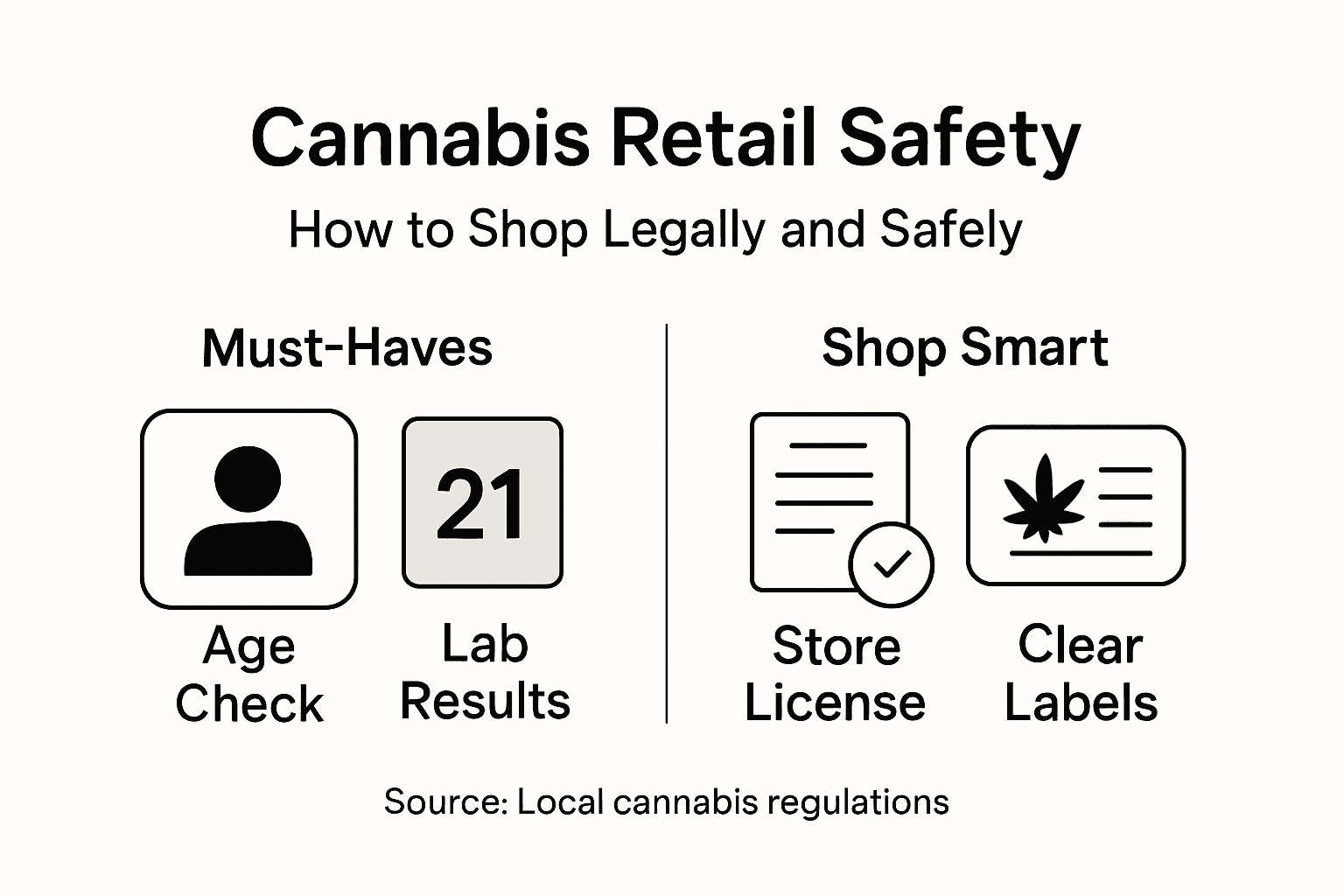
The legal cannabis retail space exists because of licensing and law. Without these frameworks, there would be no “legal” cannabis market at all. Licensing creates the distinction between legitimate retailers and illegal operators. When you purchase from a legal cannabis retailer, you’re buying from a business that has obtained specific licenses, undergone background checks, met security requirements, and committed to compliance with drug control laws. This licensing process isn’t casual. Retailers must demonstrate financial transparency, prove they have proper storage and security systems, and show they understand inventory tracking and record keeping. They also need to prove their business location complies with local zoning laws. The depth of these requirements exists for a reason: legal cannabis licensing frameworks aim to restrict youth access and ensure product safety. For health-conscious buyers, this means the retailer you’re purchasing from has passed scrutiny that illegal operators never face. Avondale Apothecary operates under these licensing requirements, giving you the assurance that products have been vetted and the business maintains compliance with regulations.
Age Restrictions and Identity Verification
Age restrictions represent the most visible legal requirement for cannabis buyers. Globally, legal cannabis retail requires buyers to be 18 or 21 years old depending on jurisdiction. In Canada, the legal age is 18 in some provinces and 19 in others. In the United States, most states that allow recreational cannabis set the age at 21, aligning with alcohol regulations. Medical cannabis may have different age limits depending on the jurisdiction and whether a minor has parental consent and a physician’s recommendation. These age restrictions aren’t arbitrary bureaucratic hurdles. They reflect public health policy based on research about brain development and cannabis use during adolescence. The restrictions aim to keep cannabis away from people whose brains are still developing.
What this means practically is that every legal cannabis purchase involves identity verification. When you buy online from a retailer like Avondale Apothecary, you provide identification that gets verified before you can even browse products. At physical locations or delivery, your ID gets checked again. Some retailers use digital age verification systems that check your driver’s license or passport against government databases. This two or three step verification process feels more rigorous than buying alcohol, and that’s by design. Retailers who sell to anyone underage face severe penalties including license revocation, heavy fines, and criminal charges. This high-stakes accountability means retailers take age verification seriously. You might need to provide your full legal name, date of birth, address, and ID number. This information typically stays within the retailer’s system and isn’t shared with third parties beyond regulatory audits.
Understanding Local Cannabis Laws
Beyond age and licensing, cannabis laws vary significantly by jurisdiction. Some areas prohibit certain product types entirely. Edibles might be banned in one jurisdiction but allowed in another. Concentrate potency limits exist in some places. Home delivery might be legal in your area but prohibited elsewhere. Possession limits differ too. You might be able to legally possess 28 grams in one jurisdiction but face penalties for 30 grams in another. These variations mean you need to understand your specific local laws before purchasing. Legal retailers can only sell products that are legal in their jurisdiction, and they can only sell to customers in areas where delivery or purchase is permitted. This is why online retailers verify your location during account creation. They’re not just checking if you’re old enough. They’re confirming you’re in a jurisdiction where they can legally sell to you and where cannabis possession is legal.
Cannabis licensing laws impose stringent controls on operators including age limits and compliance requirements because regulators recognize that structured oversight protects the legal market. When you comply with these rules as a buyer, you’re supporting that system. You’re helping distinguish legal, tested, quality-controlled cannabis from illicit products that might contain pesticides, mold, or unknown additives. Health-conscious buyers should view these legal requirements not as obstacles but as protections. The age restriction means the retailer has verified you’re an adult. The licensing means the retailer has been vetted. The location verification means you’re purchasing legally where you live.
Pro tip: Before your first purchase, visit your local or regional government’s cannabis regulation website to confirm possession limits, purchase location rules, and any product restrictions in your area, then cross-reference this with the retailer’s terms to ensure full compliance.
Key Compliance Risks and Consumer Safety
The legal cannabis market exists in a constant tension. Regulators want to ensure consumer safety while retailers balance operational costs, and consumers want access to quality products. This tension creates compliance risks that directly affect your safety as a buyer. When retailers fail to meet compliance standards, you’re the one exposed to contaminated products, inaccurate labeling, or mislabeled potency. Understanding these risks helps you identify trustworthy retailers and protect yourself. The cannabis industry faces persistent challenges including inconsistent lab testing, labeling inaccuracies, and regulatory fatigue affecting product safety. These aren’t theoretical problems. A product labeled as containing 10 milligrams of THC but actually containing 50 milligrams creates real consequences for consumers. Similarly, inadequate testing for pesticides or heavy metals means you might be consuming contaminants without knowing. Health-conscious buyers need to recognize that not all legal retailers maintain the same compliance standards.
Understanding Common Compliance Failures
Lab testing inconsistency represents one of the most significant compliance risks. Cannabis products must be tested by third-party laboratories to verify cannabinoid content, screen for pesticides, check for mold and mildew, and detect heavy metals. However, not all laboratories use identical testing methods, and some maintain lower standards than others. A product tested by a rigorous lab might show different results if tested by a less thorough facility. This creates a situation where two identical-looking products could have wildly different actual cannabinoid content. Labeling inaccuracies compound this problem. A retailer might mislabel a product’s potency based on inaccurate lab results or simple administrative errors. You purchase what you think is a mild product suitable for beginners but receive something significantly stronger. This risk increases when retailers source from multiple suppliers using different testing labs.
Storage and handling represent another compliance risk that consumers rarely consider. Cannabis products degrade over time when exposed to light, heat, or air. A retailer storing products improperly might be selling you degraded cannabis that no longer matches its original potency or profile. This isn’t just a quality issue. Improperly stored products can develop mold or bacterial growth, creating health hazards. Legal retail frameworks prioritize consumer safety through government oversight of product quality and adherence to packaging and labeling regulations, which includes storage requirements. Legitimate retailers maintain proper storage conditions, track product shelf life, and remove expired inventory. They also use child-resistant packaging that’s tamper-evident, preventing accidental exposure. When you purchase from a compliant retailer, you’re getting products that have been properly stored and handled throughout their lifecycle.
Chain of custody represents a less visible but critical compliance area. Every product in the legal market must be tracked from cultivation through sale. This documentation trail allows regulators to investigate if problems emerge and prevents illicit products from infiltrating the legal market. Retailers maintaining poor records create opportunities for counterfeit or illegally produced products to enter shelves. Some health-conscious buyers purchase premium products expecting higher quality, but without proper chain of custody tracking, they might receive substandard goods. Compliant retailers maintain detailed records of supplier information, testing documentation, and inventory movements. When you purchase from a retailer like Avondale Apothecary that emphasizes transparency through Certificates of Analysis, you’re benefiting from this documentation. You can trace products back to their source and verify testing results.
How to Protect Yourself
The best protection is choosing retailers that demonstrate compliance commitment. Look for retailers displaying detailed product information including third-party lab test results, packaging dates, and storage information. Ask questions if this information isn’t readily available. Compliant retailers welcome these questions because transparency demonstrates their confidence in product quality. Pay attention to labeling accuracy. Does the product match its description? Are potency levels clearly stated? Is there proper warning labeling about consuming responsibly? Products from disreputable sources often have generic or missing labeling. Consider starting with lower potency products regardless of your experience level. This allows you to understand your personal response without excessive risk. Track how products affect you and note the batch numbers, so if you experience unexpected effects, you can report them to the retailer.
Compare compliance risks and what to look for when selecting a trustworthy cannabis retailer:
| Compliance Risk | Consumer Impact | What to Look For |
|---|---|---|
| Lab testing inconsistency | Unreliable potency, hidden toxins | Accredited third-party labs |
| Poor labeling accuracy | Incorrect dosing, misuse | Clear, detailed packaging |
| Improper storage | Degraded or contaminated product | Freshness dates, secure packaging |
| Weak chain of custody | Risk of counterfeit products | Product origin traced, batch numbers |
Pro tip: Before purchasing, request or review the Certificate of Analysis for any product you’re considering, verify the testing lab’s name and credentials, then cross-check that the stated potency matches the labeling on the product itself.
Discover Confidence in Every Cannabis Purchase with Avondale Apothecary
Navigating the complexities of legal cannabis retail can be challenging for health-conscious buyers seeking transparency and quality assurance. This article highlights key concerns like verifying product safety through detailed Certificates of Analysis, understanding cannabinoid ratios, and complying with strict age and licensing regulations. At Avondale Apothecary, we address these challenges head-on by providing a curated selection of premium cannabis strains, edibles, concentrates, and more—all accompanied by comprehensive testing results that empower you to make informed choices with confidence.
Explore our wide range of rigorously tested products today at Avondale Apothecary and experience a seamless online shopping environment designed for your peace of mind. Whether you are new to cannabis or a seasoned consumer, our platform ensures you have the transparency, compliance, and product diversity needed to prioritize your health and wellness. Don’t wait—take control of your cannabis experience now by visiting Avondale Apothecary to start browsing trustworthy options backed by industry-leading quality and safety standards. Enhance your journey by learning more about the role of cannabis retail and how to select the right product for your needs.
Frequently Asked Questions
What are the main categories of legal cannabis products?
Legal cannabis products are generally categorized into six main types: Flower, Edibles, Concentrates, Tinctures, Topicals, and Vapes. Each category serves different needs, ranging from natural formats like flower to precise dosing options like edibles and tinctures.
How can I determine the right dosage when using cannabis products?
Start with lower potency products, particularly those with 2.5 to 5 milligrams of THC per serving. Gradually adjust your dosage based on your personal response to determine what works best for your body without unwanted effects.
What should I look for on product labels to ensure safety and compliance?
Ensure that product labels include clear information on cannabinoid content, serving sizes, warnings, and Certificates of Analysis that show testing results for potency, contaminants, and compliance with health standards.
Why is age verification important in legal cannabis retail?
Age verification ensures that cannabis products are of legal purchase age, typically 18 or 21, based on public health policies aimed at preventing access to minors. It also legitimizes the sale and maintains the integrity of the legal cannabis market.