
Finding safe and effective cannabis-derived products often feels confusing, especially with terms like CBDA cropping up alongside CBD. For health-focused adults looking to boost wellness, knowing how CBDA is made and how it differs from CBD matters. This guide breaks down the science behind cannabidiolic acid and explains its unique benefits, legal status, and the importance of transparency when choosing American-made CBDA products.
Table of Contents
- What Is CBDA and How Is It Made
- CBDA vs. CBD: Key Differences and Benefits
- Potential Health Benefits of CBDA
- Legal Status and Safety of CBDA Products
- Choosing High-Quality CBDA for Wellness
Key Takeaways
| Point | Details |
|---|---|
| CBDA and CBD Differences | CBDA is the raw precursor of CBD, possessing an additional carboxylic acid group that influences its interactions with the body. |
| Potential Health Benefits | CBDA shows promise for anti-inflammatory, anti-emetic, and neuroprotective properties, making it a compelling option for holistic wellness. |
| Legal and Safety Considerations | CBDA products must contain less than 0.3% THC federally, but varying state laws necessitate careful examination of local regulations. |
| High-Quality Product Selection | Choosing CBDA involves prioritizing organic sourcing, cold extraction methods, and third-party lab testing to ensure product integrity and safety. |
What Is CBDA and How Is It Made
Cannabidiolic acid (CBDA) is a fascinating non-psychoactive cannabinoid that serves as the raw, unheated precursor to CBD in cannabis plants. Unlike its more famous cousin CBD, CBDA exists in the plant’s natural state before any processing occurs.
The molecular formation of CBDA is a precise biological process involving specific enzymatic interactions. Cannabinoid biosynthesis begins with cannabigerolic acid (CBGA), which gets transformed through an enzymatic reaction catalyzed by CBDA synthase. This transformation happens primarily in the glandular trichomes of female cannabis flowers, where complex biochemical processes take place.
Here’s how CBDA is produced in cannabis plants:
- Starts with cannabigerolic acid (CBGA) as the foundational molecule
- Requires the specialized enzyme CBDA synthase
- Occurs predominantly in female cannabis plant’s flower trichomes
- Happens through an enzymatic oxidative cyclization reaction
The conversion from CBDA to CBD is triggered by a process called decarboxylation. Decarboxylation occurs when CBDA is exposed to heat or light, which removes the carboxylic acid group and transforms the molecule into active CBD. Researchers have determined that heating at 140°C for approximately 30 minutes provides optimal conditions for this molecular transformation.
Pro tip: For the most potent CBDA experience, seek raw or minimally processed cannabis products that preserve the original molecular structure.
CBDA vs. CBD: Key Differences and Benefits
Cannabidiolic acid (CBDA) and cannabidiol (CBD) are closely related molecules in the cannabis plant, but they possess distinct characteristics that set them apart. While they might seem similar at first glance, their molecular interactions differ significantly in how they engage with the human body’s biological systems.

The primary distinction between CBDA and CBD lies in their chemical structure. CBDA is the raw, unheated form of CBD, containing a carboxylic acid group that gets removed during the decarboxylation process. This structural difference impacts how each compound interacts with the body’s receptors and enzymes. Unlike CBD, which directly binds to cannabinoid receptors, CBDA appears to work more subtly by influencing enzyme activity and serotonin receptors.
Key differences between CBDA and CBD include:
- Chemical structure: CBDA has an additional carboxylic acid group
- Receptor interaction: CBD directly binds to cannabinoid receptors
- Metabolization: CBD is more easily processed by the body
- Potential benefits: Each compound offers unique therapeutic properties
Both cannabinoids contribute to the entourage effect, a phenomenon where multiple cannabis compounds work synergistically to enhance overall therapeutic potential. While CBD is more widely studied and available, CBDA shows promising interactions with 5-HT1A receptors, suggesting potential advantages in areas like mood regulation and inflammation management.
Here’s a quick comparison of CBDA and CBD to clarify their distinct characteristics:
| Characteristic | CBDA (Cannabidiolic Acid) | CBD (Cannabidiol) |
|---|---|---|
| Chemical Structure | Contains carboxylic acid group | Lacks carboxylic acid group |
| Source | Found in raw cannabis | Formed after decarboxylation |
| Receptor Action | Modulates enzymes, serotonin | Binds to cannabinoid receptors |
| Common Uses | Research, raw supplements | Widely used in wellness |
Pro tip: Consider consulting with a cannabis wellness professional to understand how raw CBDA or processed CBD might best suit your individual health needs.
Potential Health Benefits of CBDA
CBDA has emerged as a fascinating cannabinoid with a diverse range of potential therapeutic applications. Preliminary research reveals promising health benefits that extend across multiple physiological systems, suggesting significant wellness potential beyond traditional cannabinoid treatments.
The most notable therapeutic properties of CBDA include its powerful anti-inflammatory mechanisms. By inhibiting cyclooxygenase-2 (COX-2) enzymes, CBDA demonstrates remarkable potential in managing inflammatory responses throughout the body. This unique interaction suggests potential applications in conditions characterized by chronic inflammation, such as arthritis, inflammatory bowel diseases, and metabolic disorders.
Key potential health benefits of CBDA include:
- Potent anti-inflammatory effects
- Natural anti-emetic properties
- Potential anticonvulsant capabilities
- Preliminary evidence of anti-cancer activities
- Mood regulation and neuroprotective potential
Animal studies have particularly highlighted CBDA’s effectiveness in managing nausea and vomiting, indicating promising applications in medical contexts like chemotherapy support and digestive health management. While most research remains preliminary, the early scientific evidence suggests CBDA could become a significant player in holistic wellness strategies. Researchers continue to explore its interactions with 5-HT1A receptors, which may contribute to its potential mood-enhancing and neuroprotective effects.
Pro tip: Always consult healthcare professionals before incorporating CBDA into your wellness routine, and prioritize products from reputable sources with transparent testing results.
Legal Status and Safety of CBDA Products
CBDA exists in a complex legal landscape that can be challenging for consumers to navigate. Federal regulations surrounding hemp-derived cannabinoids create a nuanced framework where legality depends on specific chemical compositions and source materials.
Under the 2018 Farm Bill, hemp-derived CBDA products containing less than 0.3% THC are generally considered legal at the federal level. However, state-level regulations can vary significantly, creating a patchwork of legal interpretations that consumers must carefully understand. The non-psychoactive nature of CBDA distinguishes it from more regulated compounds, but this does not guarantee universal acceptance across all jurisdictions.
Key legal and safety considerations include:
- THC content must remain under 0.3% for federal compliance
- State laws can differ dramatically from federal guidelines
- Product quality and testing remain largely unregulated
- Potential interactions with medications are not fully understood
- Individual health conditions may impact safe consumption
Product safety remains a critical concern for CBDA consumers. The FDA has not approved nonprescription CBDA products, which means quality control and labeling accuracy are not consistently guaranteed. This regulatory gap means consumers must exercise significant due diligence, seeking products from transparent manufacturers who provide comprehensive third-party lab testing results and clear ingredient documentation.
Pro tip: Always verify a product’s third-party lab results and consult healthcare professionals before incorporating CBDA into your wellness routine to ensure personal safety and legal compliance.
Choosing High-Quality CBDA for Wellness
Selecting premium CBDA products requires a strategic approach that goes beyond simple marketing claims. Careful product evaluation techniques are essential for ensuring you receive a safe, effective wellness supplement that maintains the compound’s delicate molecular integrity.
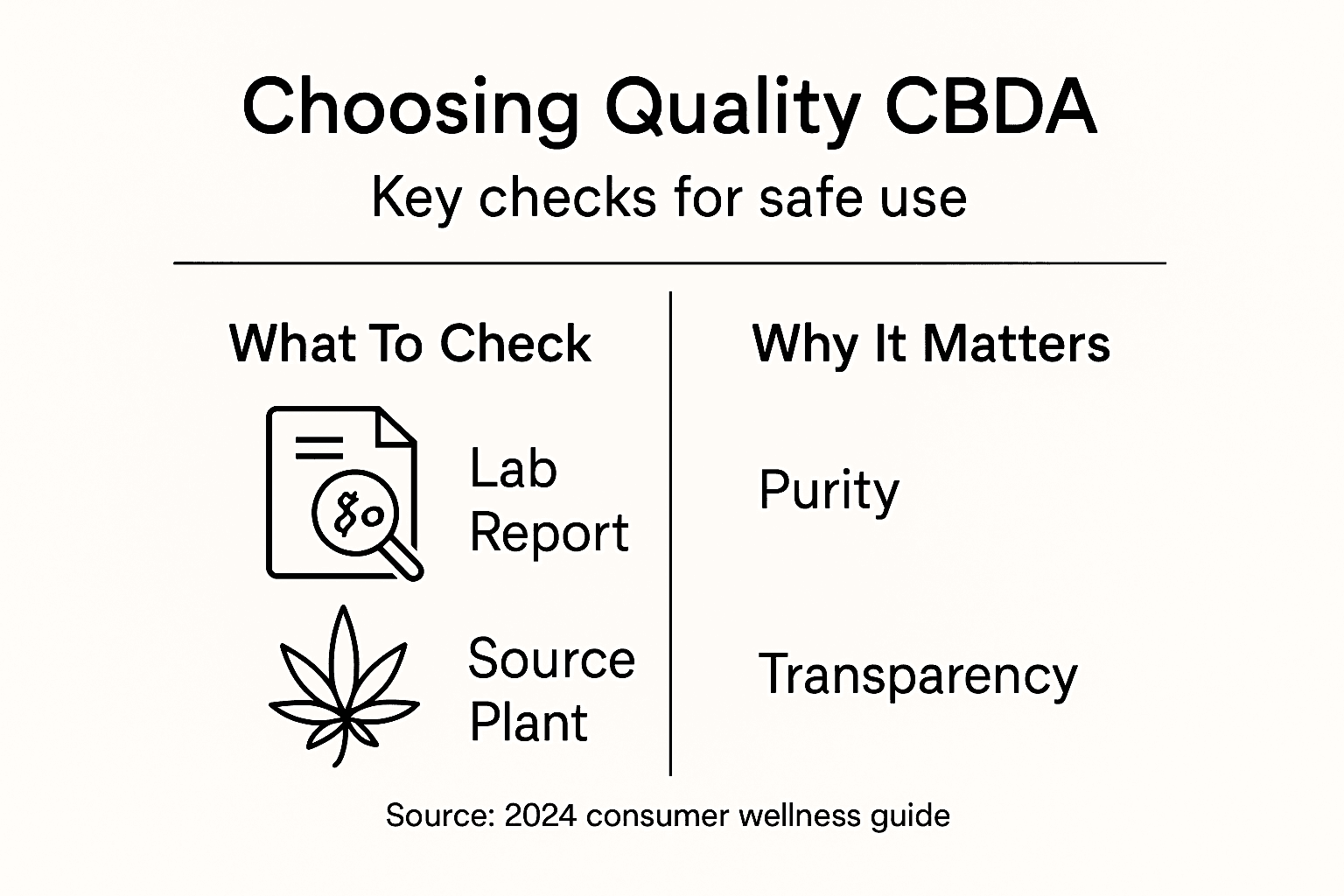
The extraction method plays a crucial role in preserving CBDA’s therapeutic potential. Cold extraction techniques, such as CO2 extraction and cold-press methods, help maintain the cannabinoid’s original acidic structure without converting it to CBD through heat-induced decarboxylation. These advanced processing techniques protect the molecule’s unique chemical profile and potential wellness benefits.
Key factors for selecting high-quality CBDA products include:
- Organic hemp sourcing
- Cold extraction methods
- Comprehensive third-party lab testing
- Transparent Certificates of Analysis (COAs)
- Verifiable cannabinoid content
- Absence of contaminants like pesticides
Consumers should prioritize manufacturers who demonstrate transparency through detailed product documentation. Full-spectrum and isolate products offer different potential benefits, so understanding your specific wellness goals becomes critical. Independent lab testing provides crucial verification of cannabinoid profiles, ensuring you receive a product that matches its labeled specifications and meets rigorous quality standards.
To help you evaluate CBDA product quality, review these important selection factors:
| Factor | Why It Matters | What to Look For |
|---|---|---|
| Source of Hemp | Impacts purity and safety | Certified organic farms |
| Extraction Method | Affects CBDA content | CO2 or cold-press techniques |
| Lab Testing | Ensures accurate labeling | Third-party COA availability |
| Contaminant Screening | Protects against toxins | Zero pesticides or heavy metals |
Pro tip: Request and thoroughly review the product’s Certificate of Analysis before purchasing, paying close attention to cannabinoid content, potential contaminants, and extraction methods.
Discover the Power of CBDA for Your Wellness Journey
If you are intrigued by the unique benefits of CBDA and want to explore high-quality products that preserve its natural properties, Avondale Apothecary is your trusted online destination. We understand how important it is to find cannabis items with detailed Certificates of Analysis (COAs) and transparent sourcing so you can confidently embrace CBDA’s anti-inflammatory and mood-supporting potential.

Start enhancing your well-being today by exploring our carefully curated selection of premium cannabis products at Avondale Apothecary. Whether you want raw CBDA options or products crafted to maintain its delicate profile, visit us now to experience quality, transparency, and wellness aligned with your goals. Take the next step toward informed cannabis choices with resources and verified lab results readily available for you.
Frequently Asked Questions
What is CBDA and how is it produced?
CBDA, or cannabidiolic acid, is a non-psychoactive cannabinoid found in cannabis plants, serving as the raw precursor to CBD. It is produced primarily in the trichomes of female cannabis flowers through a biochemical process involving cannabigerolic acid (CBGA) and the enzyme CBDA synthase.
How does CBDA differ from CBD?
CBDA differs from CBD in its chemical structure, as CBDA contains an additional carboxylic acid group. This structural difference affects their receptor interactions; while CBD directly binds to cannabinoid receptors, CBDA influences enzyme activity and serotonin receptors more subtly.
What potential health benefits does CBDA offer?
CBDA has shown potential health benefits, including powerful anti-inflammatory properties, natural anti-emetic effects, potential anticonvulsant capabilities, and preliminary evidence suggesting anti-cancer activities. It may also assist in mood regulation and neuroprotection.
What should I consider when choosing CBDA products?
When selecting CBDA products, consider factors such as the source of hemp (preferably organic), extraction methods (like CO2 extraction), third-party lab testing for accurate labeling, and screening for contaminants to ensure product safety and quality.